What does an object receive from the person who makes it?
From an early age we teach our children to divide the world around them according to a grammar of being: into the animate and the inanimate. We will notice how they immediately squeeze a middle category in between, let’s call it that of “things to which I have given a bit of my own soul”. Teddy bears, dolls, pillows and little blankets can become imbued with sensitivity and love and will enter this species of being. But since the human brain tends not to leave already allocated alveoli to fall into neglect, once we become adults we populate this territory with cultural products (well, nostalgic infantilism fills it with useless gadgets). Writing cannot be seated at the same table as stones, nor can we place music next to the clothes iron. Conferring being, charging the things around us (still life) with consciousness, is essential to our way of being in the world. Nature (the living kind) was, for thousands of years, the seat of unknown dangers for humanity, before being transformed into a garden of tourist delights.
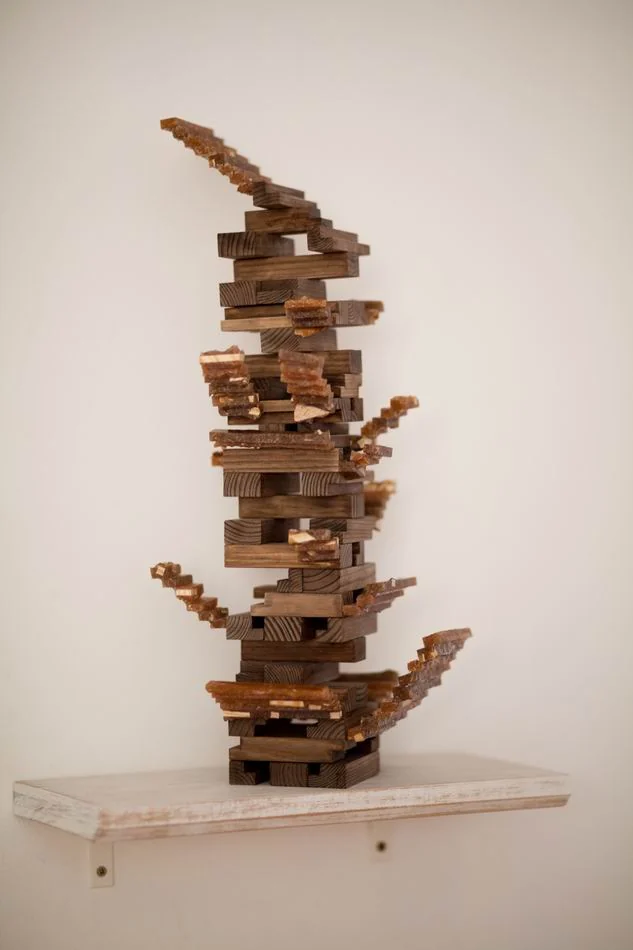
For Tets Ohnari, producing a work of art means separating an object resulting from the creative act, the artwork, from a remainder. In sculpture this is obvious (the rest of the material is thrown away); in painting we can even invoke the empty space in the paint tubes; in music, the totality of unused sequences of sounds. It is what remains of the infinite potential of an infinite universe when we carry out a conscious actualisation. Artistic intervention cuts out a part and gives it a shape from the mind, while the rest returns to the indefiniteness of nature. And, as in childhood, we carefully separate the part to which we have given something of our soul from what is merely the dead agglomeration of atoms.
The image in which a person, a Gogolian soul, attaches their name to an institution, an impersonal entity defined by brand, logo and address, is the schizoid manifesto of business cards. It is a sort of reverse artistic act meant to facilitate communication. Exchanging business cards is not a meeting between souls: they have brought along creatures that are by definition incapable of being ensouled, to speak in their place and to recognise each other instantly, without doubt. It is a polite unloading of consciousness.
And being placed in the art world, where creation and the market sit on the same chair, offers an unexpected shortcut to understanding the destiny of the artwork. It leaves the creator’s studio charged with soul, only to be dispossessed of it when it becomes merchandise, well protected by bubble wrap, transported in special crates, squeezed among others with a label revealing its name and price. But it can receive its soul back tenfold in the intimacy of another person willing to look at it in a particular way. (Cristian Cojanu)
In “Monos”, Tets Ohnari sets questions in motion about the work, the material left behind and the value assigned to an object.
Cristian Cojanu’s text follows its journey from studio to market. An encounter with a viewer can restore what a label and price seem to take away.