Cișmigiu, more than a place on a map.
For me, Cișmigiu Park is the heart of Bucharest. Every time I need to soften the noise and fury of the day, I go there. I don’t have to do much; it is enough to sit on a bench like an old man. If it is the middle of the week, all the better: my fellow strollers are even fewer, and the extremes of age seem very well represented, the old and the children are always there. Having grown up here, Cișmigiu works for me as a great installation for psychic decompression; it is Abraham’s bosom, an Edenic garden that speaks to me directly. “Pairidaeza” was the old Persian word for park, those gardens of delight where the aim is to enact Baudelaire’s line: “Là, tout n’est qu’ordre et beauté, / Luxe, calme et volupté.” Domesticated, ordered nature has fertilised humanity’s imagination to such an extent that every image of heaven inevitably calls on a garden. The Persian “pairidaeza”, which meant walled garden (enclosure), was taken up eagerly, the baton passing through Greek and Latin all the way to the modern languages. It produced “paradise”, the orderly monotheistic version of the Elysian Fields. It is the place beyond where nature, God’s first creation, lives in complete harmony with his supreme creation, man. Every park tends to have this kind of effect. Of course, it will never fully achieve it; many horrors happen in paradise. Here I was bitten by a dog for the first time, saw children fighting, also for the first time, lovers quarrelling, crows devouring an injured pigeon. In the explosion of spring, along with the cooing of birds and the reassuring shrieks of children, the park’s madmen appear. They are familiar and lugubrious, holding cavalcades of conversation with spirits either gentle or agitated. You are never sure that all sighing and sorrow have vanished, that there is no danger left; the madmen warn you that unseen threats still exist. The park as an earthly paradise presupposes that once nature has been sanitised and domesticated, once there is no longer any danger for man, calm and voluptuousness set in, a languor that cancels evil. Of course, that is not so. What is more, the park is a litmus-test psychic apparatus. It shows in full that evil has no natural substance, that it is produced by people or merely named by people, that we carry it with us wherever we go. In vain do we geld nature of the forest’s uncertainties: when a human being appears in the “pairidaeza”, the stage lights up and Lucifer appears.
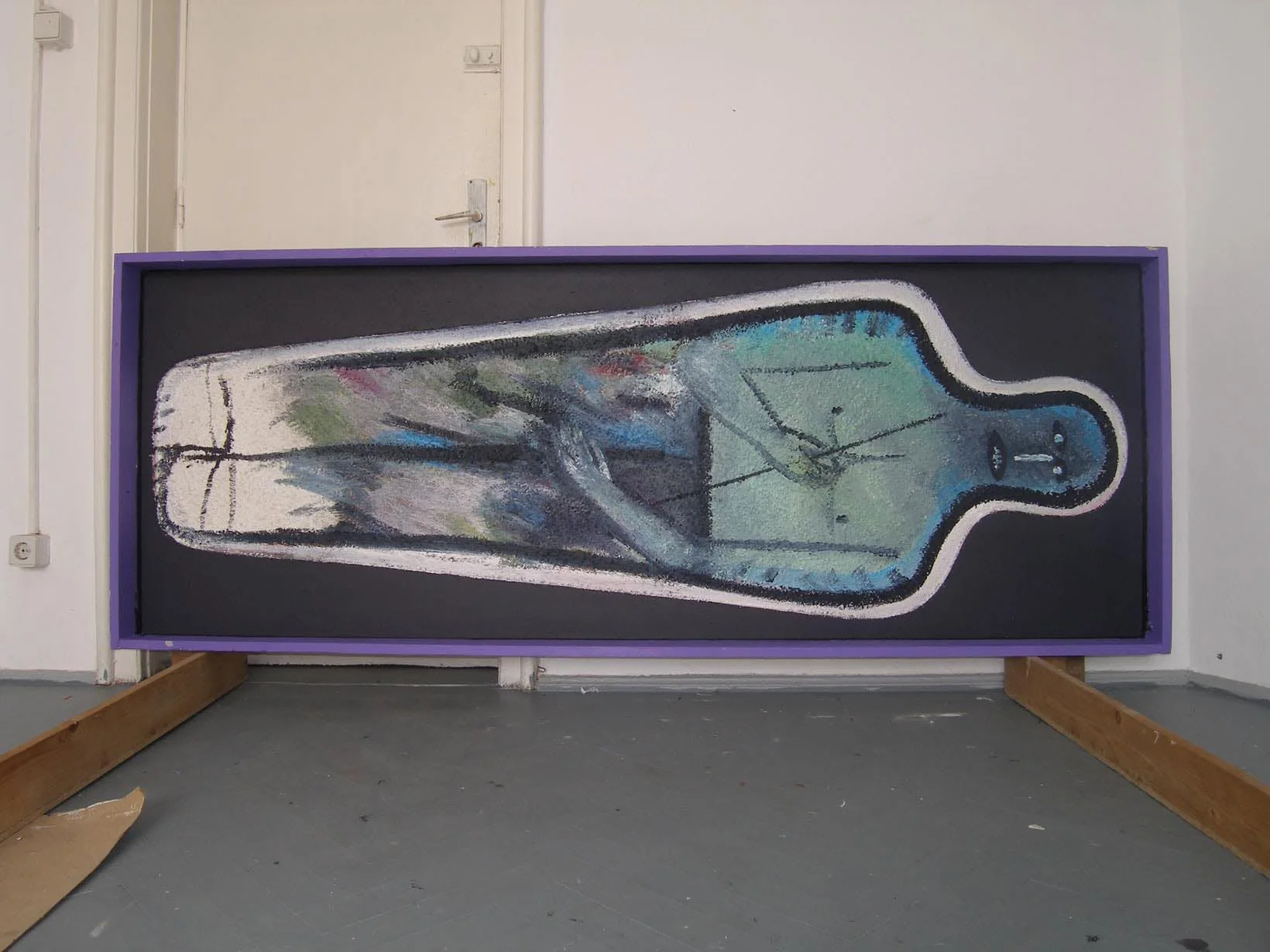
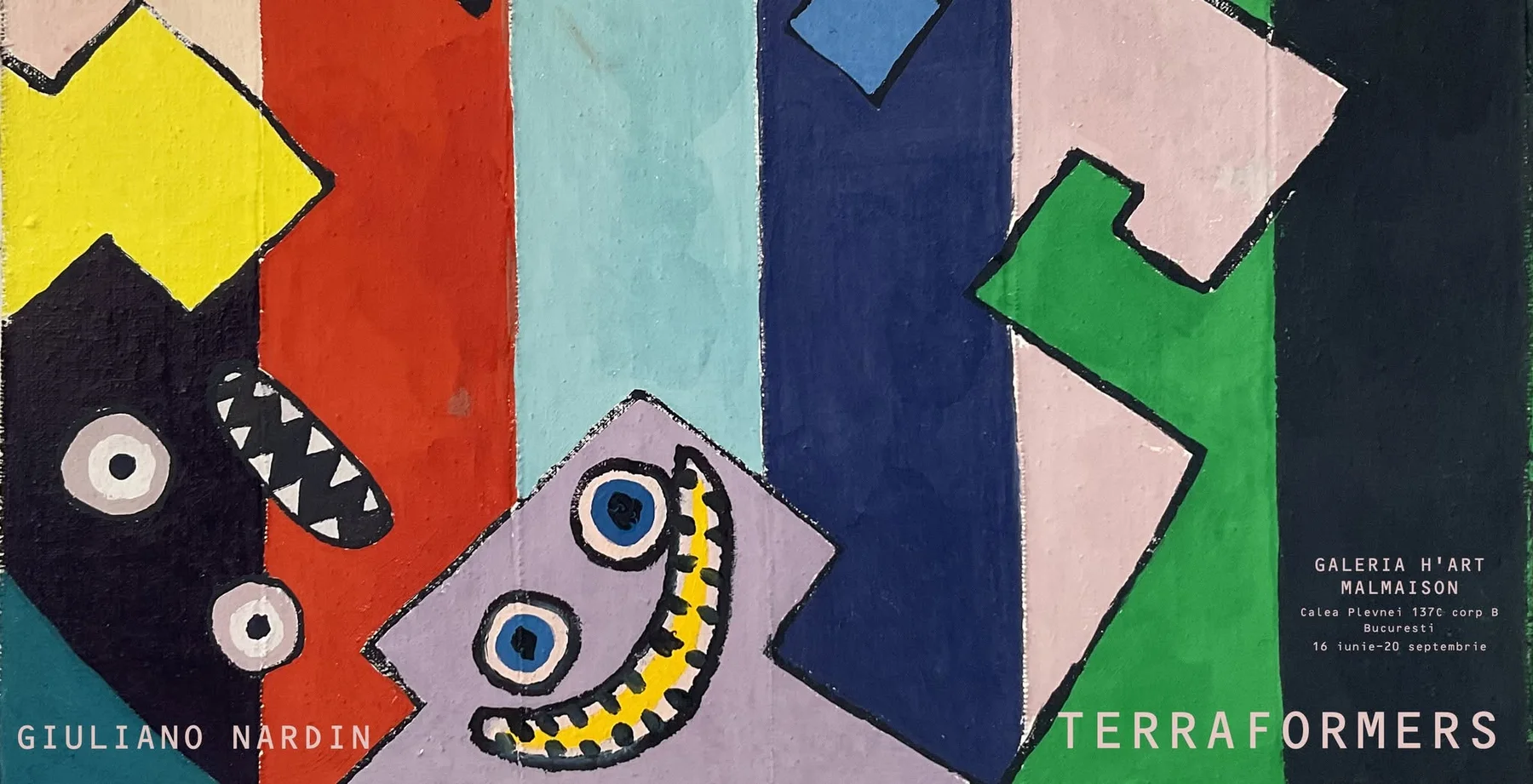
Giuliano Nardin’s daily ritual is a walk in Cișmigiu with his son. The series of works now on view were all made in 2018 and stage precisely this kind of ambivalence of the park. For Giuliano it is a place of childhood where cries of terror ring out, where little toy robots are frightened, where swans are now calm, parading in a group as on a fashion runway, now melting into a storm on the lake. Women are now sunbathing voluptuously, now caught up in an apocalyptic staging in which hands are raised in despair. The animals look like friendly puppets, with fangs bared in an intimidating grin. Yet aggression is turned into circus, and Giuliano makes one more effort to balance the space of the garden of delights. Evil is caricatured through the archaic style; it is tamed, becomes unreal and comic, is transformed into benign childish fantasy. It is a “god-like mode” of looking at the filth that man secretes continuously, even in paradisiacal places. In Cișmigiu an artist still has work to do: he is the park keeper responsible for Edenic balance, he must tidy up the imaginary and, as far as he can, clean man of the ballast of his so heavy stigma. (Dan Popescu)
Giuliano Nardin’s second solo exhibition occupied the halls of the Institute of Architecture in autumn 2018.
Organised by Dan Popescu, the selection was dedicated to the park near the artist’s home. An external place became an inner territory too, revisited and transformed through painting.