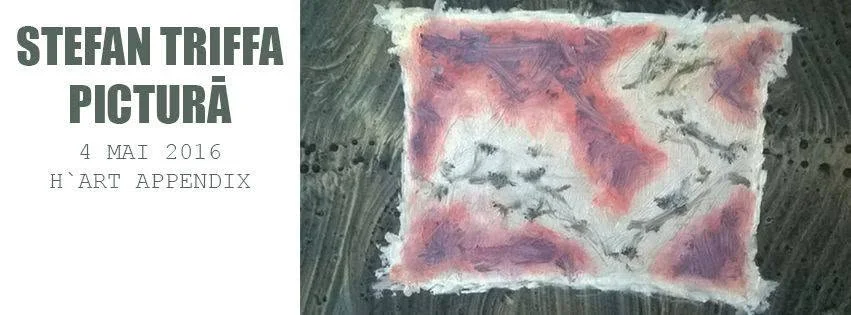
A Levantine in New York
The art of the new generation most often leaves art lovers with modernist expectations perplexed. Where has Beauty gone, what happened to harmony, why do artists choose to become entertainers or civil-society activists? We seem to have a solid modernist tradition, and the new generation of artists is trying to react against it. At first sight, a situation similar to what was happening in the United States in the early ’60s, with the emergence of pop art. And yet one part of artistic modernity, one of the most influential, was hardly assimilated at all in the Bucharest landscape: American abstraction with all its branches, action painting and color field painting. Gestural abstract aestheticism has been very poorly represented in Romania. In a way, this is understandable. A favourable cultural context is needed for the desire for the non-figurative to be a sincere one. The Romanian is, rather, an iconodule. Stefan Triffa trained in New York with Theodoros Stamos and Richard Pousette-Dart, two important painters of the American modernist school. It is a school that works around a simple equation: sincerity, non-figuration, aestheticism. New York abstraction is the cultural product of a specifically Protestant tendency towards austerity, the direct visual consequence of this iconoclastic spirit. The Levant is the opposite of formal austerity. It is flesh and honey and blood all at once. Often slag, too. Historically, before 1989 American abstract art was identified with imperialist-capitalist decadence. Information entered the country with difficulty and was censored. Romania missed the dialogue with a series of decisive experiments in post-war contemporary art. Besides American abstraction, we almost entirely missed the encounter with minimalism, conceptualism and their echoes. Stefan Triffa is a painter who tries to fill the gap between the two cultures.
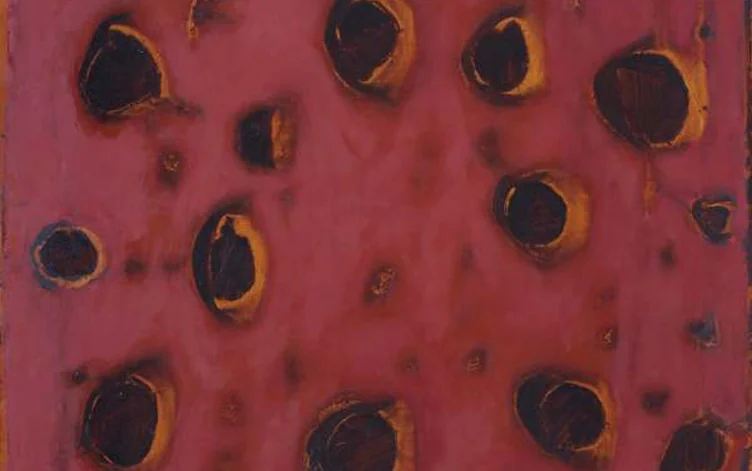
Stefan Triffa does not make abstract art, if by abstract we mean a generic experience. His is a personal art, which he builds carefully every day. I have always looked with slight envy at people who manage to simplify their lives, find their goal and concentrate on it completely. Stefan is one of them. From the moment the day begins, everything is subordinated to painting. From breakfast to the glass of wine after lunch, everything is an existential strategy that puts him in a position to paint. The process is wholly present in the painting. Spirals, fractures, forms produced by decalcomania, all born of a mature, well-tempered enthusiasm. His gesturalism creates chromatic twists that invite the eye into the illusionistic space of the picture. If Barnett Newman’s large monochrome paintings had as their symbolic stake the rendering of the experience of the sublime, Triffa’s paintings are charged with a diffuse symbolic conglomerate. It is a well-tempered heroism, a mature “music”, slightly disenchanted yet self-possessed. It is the resolute intimism of a painter “in the prime of life”. Triffa does not live on the emotional abysses of a Mark Rothko or a Jules Olitski. Nor does he opt for the depersonalisation of the pictorial act, as in hard-edge art. He lives in the interval. As, indeed, do all of us. He is an abstract painter who keeps the illusion of space and is not afraid of affective symbolism. He is a Levantine living in New York. “A human art, all too human” was my first thought in front of a canvas in the small, sparsely furnished studio near Cișmigiu. Our conversations showed me I was not wrong. Triffa is a sociable artist whose art is the fruit of the tender, intimate questions everyone asks themselves late at night. Unmasked questions, sometimes painful, that only sleep lets you escape.
Text: Dan Popescu
H’art’s presentation opened on 12 May 2006 and remained on view until 3 June.