The films a collage can make.
“He likes to show you collages (if you’re not a fool and you have a sense of humour. He catches on right away whether your eyes are sparkling or whether you’ve been a bit tired since birth). He explains things and tells you all kinds of details, and then he offers to teach you too (but he laughs slyly, he knows you won’t pull it off). You need an eye and a memory (he keeps thousands of silhouettes already cut out, and when he starts working he knows exactly where to look, in the 6-kilo sack of priests and crosses, in the 4-kilo one of socialites, for what the composition in his head dictates). He slips imperceptibly into the skin of the artist, handling a kind of grace: what I see, nobody sees. Then he reassures you, if he sees you too overwhelmed by the intimacy of the Master of Collages: I don’t really play the artist, like some do. But if people come with flowers and ask me, what am I supposed to say, that I’m a bum? I’m a director of collages. Nea Ion Bârlădeanu. But let’s rather talk about the collages.
Before ’89, people were so dumb they watched Ceaușescu on television. Without spitting on him, without punching him as he would have deserved, the damned idiot. A fool who fooled even many clever people; because unless you became some kind of scumbag, you couldn’t get hold of food, like the scumbags in his collages. Those ones got by.
A world of Avicola “gangsters” and of traffickers in fresh eggs, in sheep’s curd, bread, butter and cheese, a world he knew very well. That is what should have been shown on television. Films should have been made from this real world, of struggling people living extraordinary adventures as they tried to get medicine for their parents, milk and meat for their children. And these films should have starred Sophia Loren, the most beautiful woman in the world, because it’s not Liz Taylor, as everyone thought, since they said on television she had purple eyes, with Yul Brynner, with Charles Boyer, with the greatest actors in the world, with Toma Caragiu, Amza Pellea, Dem Rădulescu and Draga Olteanu. That is what Sergiu Nicolaescu should have done. But he didn’t make them, and that is how Ion Bârlădeanu’s collages were born.” (Cristian Cojanu)
Anyone who has had even a little experience of studio practice knows that absolutely everything that happens there has a ritual character. It all starts at the entrance: how you stepped in, with the right foot or the left, did you shower, did you eat, did you get some water, did you make sure there was nothing left to do among the things of the world, that is, did you switch off your phone or put it on mute, right? You put on some music and that’s it, you’re on track, and only then does the adventure begin. It’s you with yourself and you can no longer blame anyone; there’s no point in bravado or in conquering any social stronghold. Yes, a few of the past day’s bitternesses follow you, but with a little effort and some concentration you leave them behind, you forget them and they quickly fade. Half a glass of wine helps, no more, you have to stay sober, you only have a few hours tonight and it’s important to stay sharp. Now the chaos begins, the hell and the legion of devils. They are all yours. Don’t fall asleep, try to stay on your toes as long as you can. It is the road to clarity.
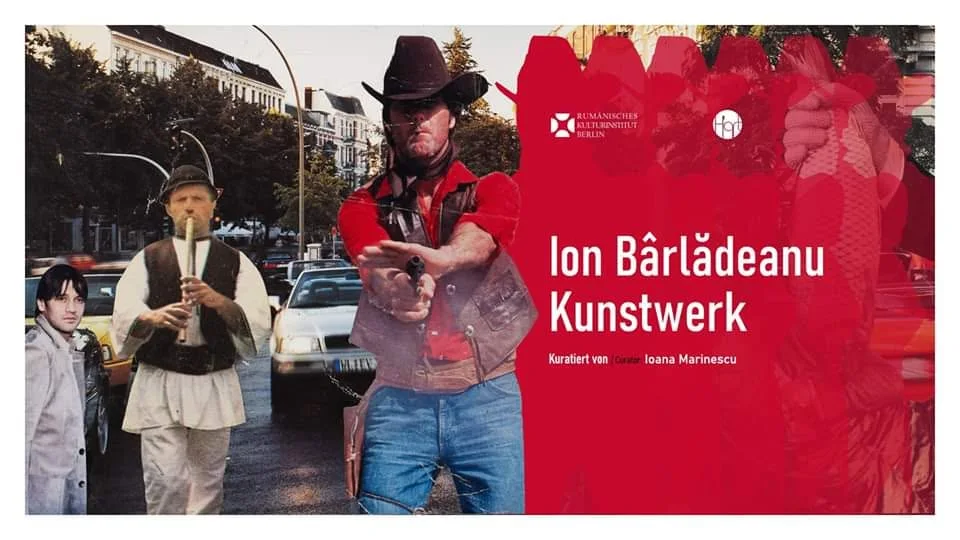
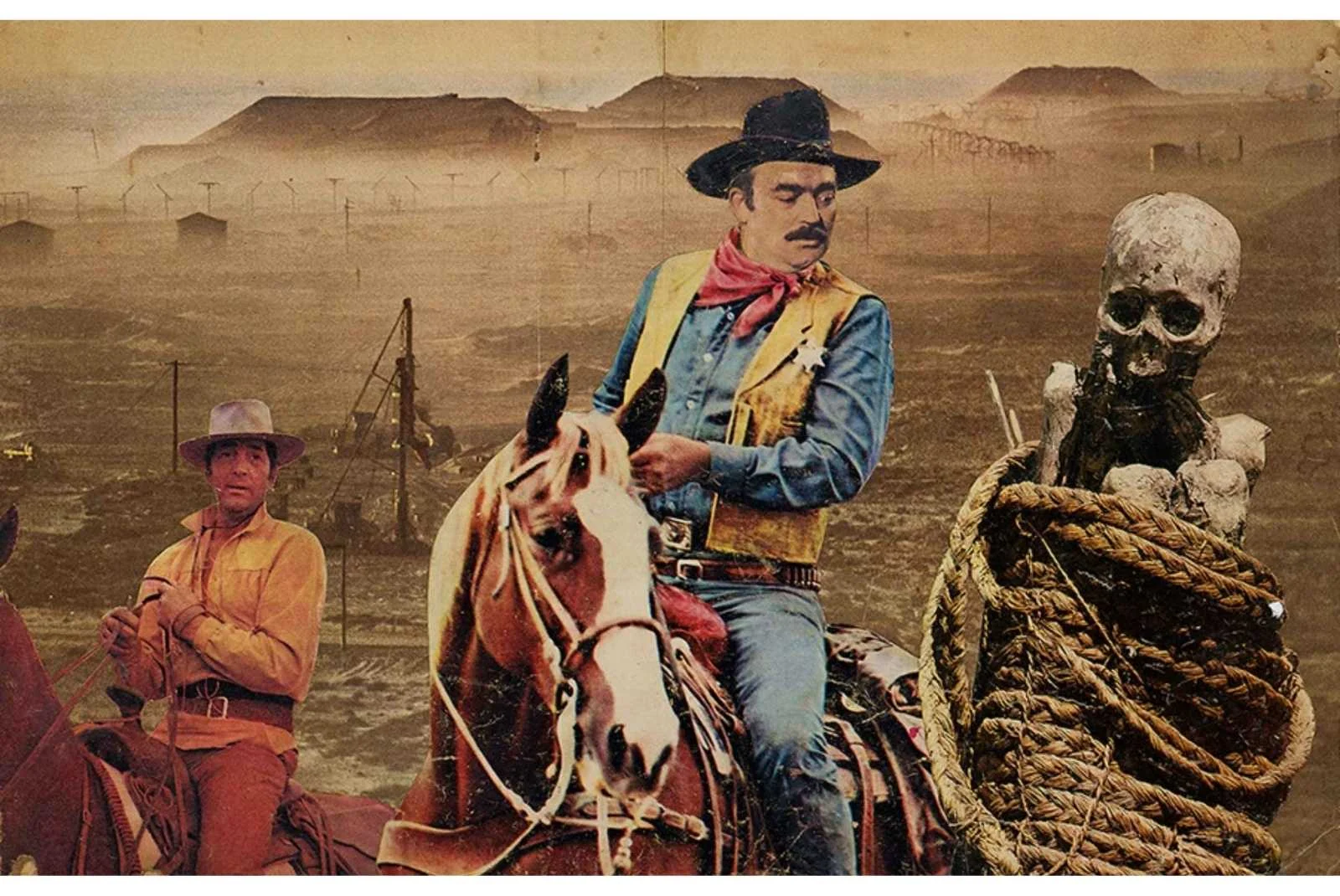
That is roughly what a “studio” situation looks like, and you will say that Ion Bârlădeanu does not work artistically along such coordinates. Well, when nea Ion works he forgets about his cigarette, about time and about his beer. He usually does it in autumn, when it is no longer hideously hot outside. He is constantly cutting out characters and classifying them; they are his colours. Clipping the useful images is a highly ritualised process, it is poetry to witness. But the actual work, that is, putting the collages together, he does in autumn or winter, his favourite seasons, in the evening, in a sustained push that can last for weeks. What actually happens there? As is well known, Bârlădeanu dreamed of being a film director. All the collages have a cinematic quality, they tell a story and each one can be classified in a film genre. He has cult films, tragedies, love films, comedies, action films, historical films, war films, westerns, gangster films, sci-fi, political films and even xxx films. He uses all the great stars for free, and any public figure can act in his “films”. Each collage is the staging of an obsession, the externalisation of an inner demon. For the author, the process of putting a work together functions as a release, a way of shedding tension. Nea Ion’s final images also gain their style from the fact that he does not know the art history of collage. Emerging with modernity, the artistic collage has a flat character: Braque and Picasso have canvases organised in a cubist way, without spatial recession. Everything happens in the foreground; there is no second plane on the canvas. Even pop collages do not show the attention to spatial organisation that we can observe in Bârlădeanu’s works. Without knowing these cultural “facts” and without caring about them, nea Ion made his own films, refining his collage technique so that it would serve his original wish to make the films he longed for. In the present exhibition we will go through the genre of gangster films. These are the films where violence is queen, crime is sexy, and agony and ecstasy are the main brushstrokes. In the end, however, the artist has clean hands. Action! (Dan Popescu)
For “Cu mîinile curate”, Ion Bîrlădeanu presented collages drawn from the imaginary world of gangster cinema. Cut-out figures become the cast of scenes organised around violence and dramatic tension.
Dan Popescu’s accompanying text follows the artist’s cinematic method. The exhibition opened at H’art Appendix on Calea Victoriei on 25 September 2015.