Sandbags around a monument, as in Odesa.
We did everything that is Romanianly possible
The ugly face of war is in everyone’s feed. If we were to analyse, stylistically, the new images of this conflagration, perhaps the most filmed in human history, what could we say? First of all, we notice an abundance of images of ruins: burnt, riddled apartment blocks, heaps of bricks mixed with human artefacts. Military hardware, once destroyed, is charred and rusted at the same time. Nothing new so far; these are scenes that seem lifted from the Second World War, yet they have the hi-fi sheen of digital film. The massacres are pixelated, every presence of death is blurred; it is a war with all the horrific details of any other war, plus an added awareness that it is being watched by billions of phone eyes.
For people in the art world, what struck most was the way the citizens of Odesa, waiting for the bombs, tried to prepare their statues by wrapping them in white sacks. The works turned into Cambodian temples built in the image of the Michelin man. For an artist this visual effect is very interesting; a stylistic contradiction sets in there, and we will come back to it. We will do so because it was underlined by the intervention of a Romanian artist, Nicolae Comănescu, in the city of the god Vulcan: Reșița.
What happened? Let us start with the context. Those who run Reșița have imagined a vision of the future for the city. It is not an invention; it is a scheme already used in the West to convert single-industry towns. The solution is simple: tourism and culture. Reșița is ideally placed for this transformation, well positioned in relation to Timișoara, another city that will grow both economically and culturally in the coming years. In visual culture, for more than a year now, I have noticed a coherent line through which Romanian artists are invited to make exhibitions and to work with public space and/or its ruins. Before Nicolae Comănescu there was Gorzo, with an exhibition at the museum and a project that turned a department store into a temporary ark full of art. In effect, Reșița does itself the honour of inviting a contemporary artist with a body of work to work with the city, an initiative that is a pleasant surprise.
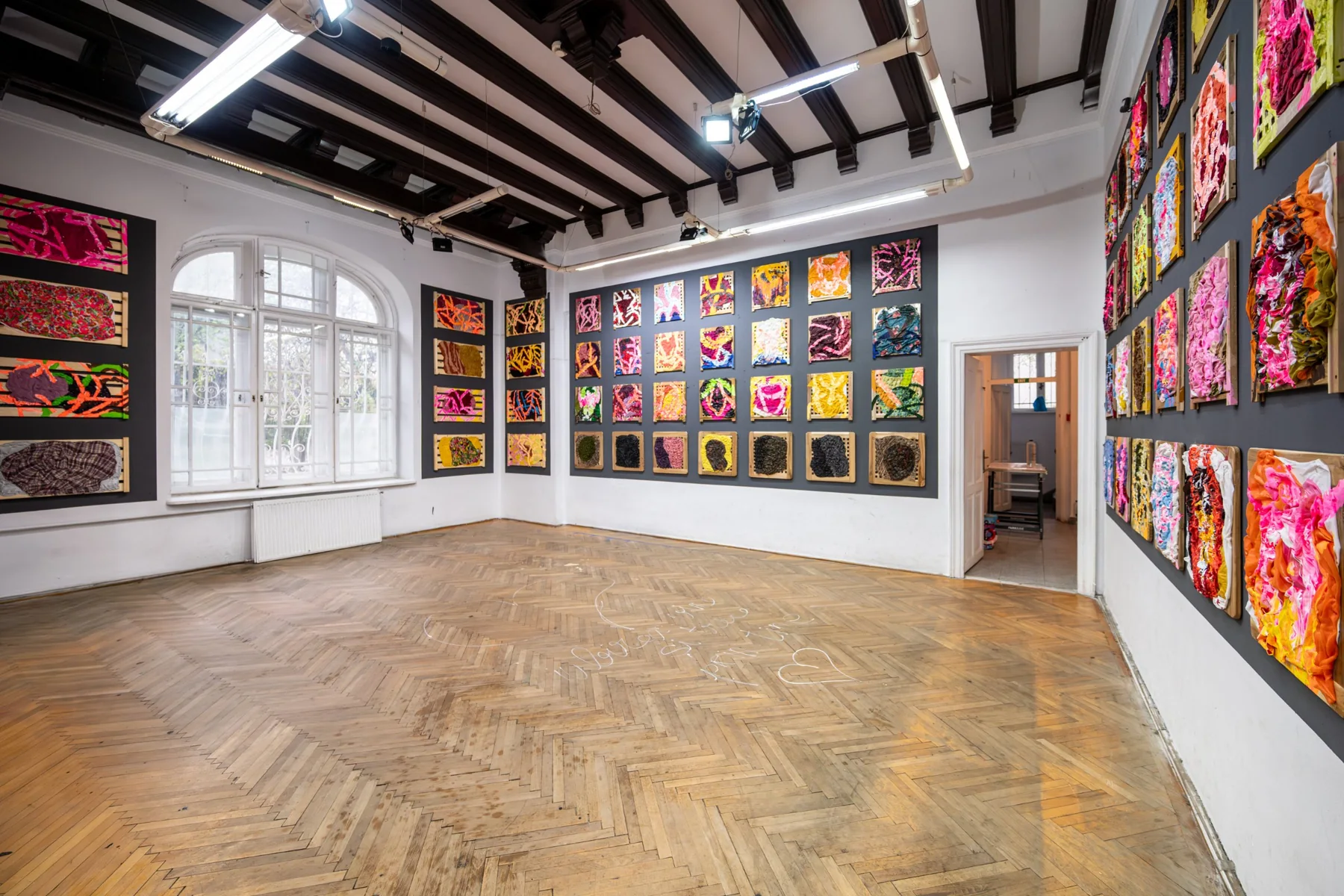
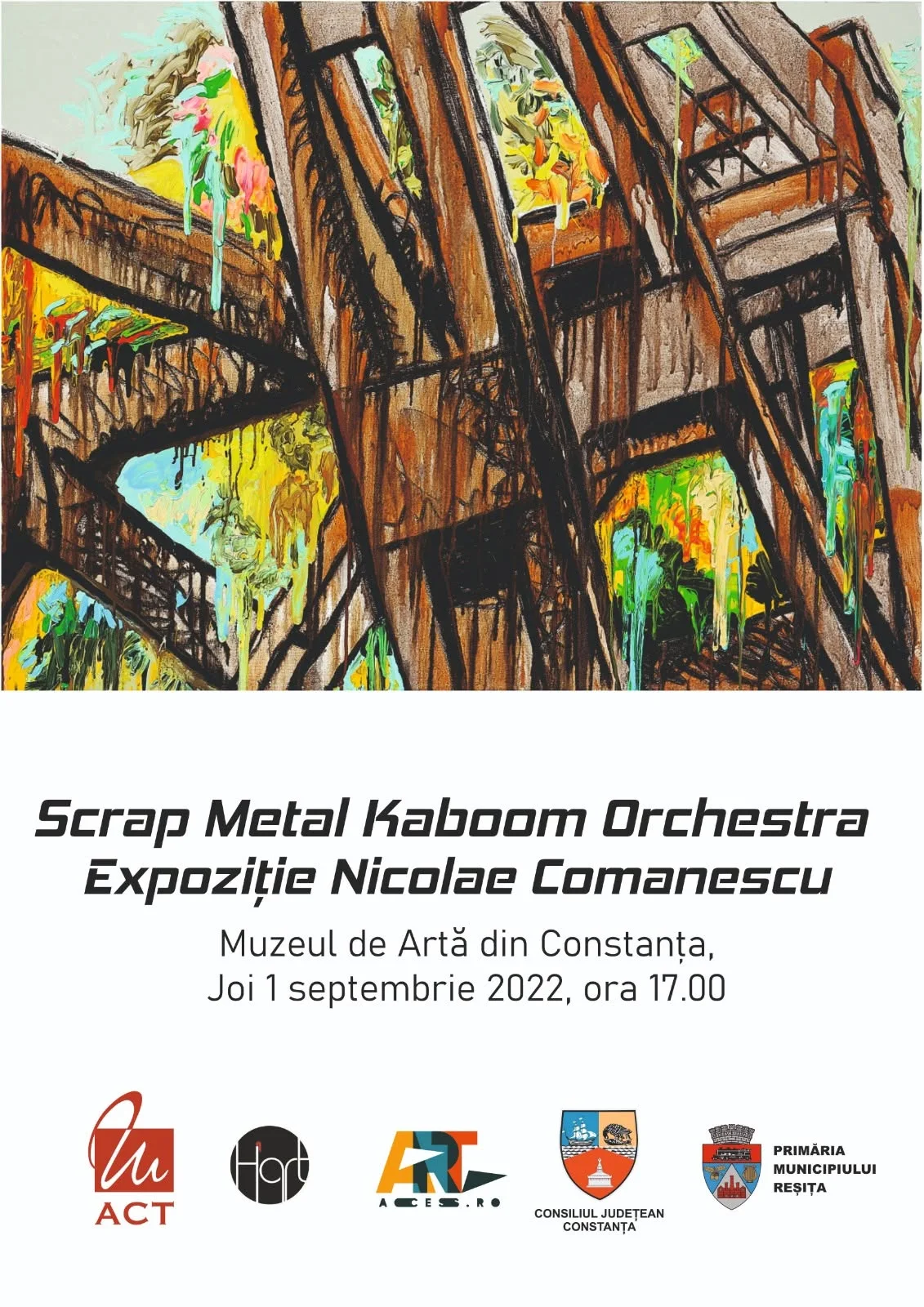
Now it is Nicolae’s turn. In his first intervention Comănescu applied an earlier approach of his: he photographs places, collects dust, earth, brick and rust from those spaces and makes pigments out of them. With those pigments he painted those very industrial views. It is as if you made a portrait with an extract of the sitter’s own flesh. The result was a series in which scenes of industrial ruin were brought back to life through warm painting with a mambo rhythm and a whiff of mojito. Several works dealt with the damage to the Pittner house, a former interwar school that is to be renovated. Ten works showing the former ruin will live in the rebuilt house as a reminder of its rebirth. A generous catalogue covering the whole series was launched in Bucharest.
In the second act, struck by the war and its iconic images, Comănescu proposes an intervention in public space. It should be said that N.C. belongs to a generation trained in the thick of the transition, an existentially very difficult period for many artists. The effect of that artistic youth full of hardship turned into a motto: “The fewer the means, the greater the effect”, the watchword of his generation. The proposed intervention has this austere character: Nicolae planned for the base of Constantin Lucaci’s Heroes’ Monument in Tricolor Park to be wrapped in sacks, in sympathy with the Ukrainians’ efforts to protect their statues from shelling. It is a non-invasive, recyclable intervention; in the end the sandbags are not lost. Minimal costs, maximum effect.
Eight years ago N.C. had a similar project. It was called “Thermal rehabilitation against all the vicissitudes of the plinth’s fate”, part of “Proiect 1990”, a series of interventions on the plinth of the Lenin statue in front of Piața Presei Libere. The curator, Ioana Ciocan, drew on a series of art actions in Trafalgar Square, where an empty plinth was used by contemporary artists. What Nicolae did was ironic, the trademark of the Rostopasca group: the plinth was thermally insulated. It became a kind of white Kaaba, a soft modernist block, an absurd apparition. It was a subtle critique of the way we manage to ruin architecture by protecting it from the weather. The plinth is, on the other hand, a plastic form but also a way of making something precious, of staging the “sacred”. Put something on a plinth and the magic happens; that something is raised to another ontological level. The strategy of the pedestal belongs to a whole arsenal artists use to produce the effect of the “precious”, along with the gilded frame, the apse or the white space of the gallery.
With a plinth, if it is public, the bigger it is, the more we are dealing with a public monument with a propaganda function. That is the case of Lenin’s pedestal and, obviously, of Lucaci’s heroes’ monument. N.C.’s action in Reșița is titled “Worse than Death”. Now, the artist’s main intention was certainly to echo what is happening in Ukraine, the padding of the plinth with sacks showing compassion for those who want to protect themselves from the scourge, but also highlighting the fact that what is a simple utilitarian gesture in Odesa is an artistic gesture in Reșița. And only a few hundred kilometres separate us.
In the same vein, it should be said that, on the surface, the sandbag intervention in Reșița seems to invoke a strategy of “wrapping” a volume, as we saw with Christo and Jeanne-Claude. Everyone knows their famous wrappings of the Reichstag or of the Arc de Triomphe in Paris. With Christo the tarpaulin covered the entire building, and the aim was to make the viewer aware of the building’s volume, that faceless myth of architects. By hiding the decorative details that also signalled the building’s function, ideologised architecture was reduced to mere volume. Draping produced a kind of cancellation of the architecture of power.
With Comănescu we get more humour in the case of Lenin’s plinth and more painterly warmth in the case of the Reșița monument. Both gestures are protective: the red communist plinth is thermally insulated (an absurd gesture inspired by a real event in Craiova), while the black pedestal of the Heroes is protected from bombs falling in another country but, symbolically, falling here too. It is also worth noting that the sacks protecting the base of the pedestal are not entirely effective. If a bomb were to fall, the subject, the stainless-steel flame of Lucaci’s statue, would be blown away. So the gesture should not be read as utilitarian but rather as symbolic and ironic: the base, the foundation, is protected, but by thickening its volume the viewer is confronted with a reality, namely that before we judge the Russian-Ukrainian conflagration we must realise that it is the product of these emphatically nationalist gestures in which our dead are martyrs and their memory produces sad, enormous pedestals of black and red marble.
Comănescu tempers the grandiloquent effect of the statue by putting something soft on something hard, which softens precisely the volume that gives the monument its bombast. The sacks at the base become a kind of soft raft or barge that makes the whole edifice levitate, so that it becomes less threatening. You feel like sitting there, at its base, having a beer with friends.
Besides, we notice that Nicolae left the work unfinished: a few sacks are missing, as if they had run out. It was obviously a conscious choice, and its meaning has to do with the way Romanians manage, even with the best intentions, not to finish a project, to miss it on the home stretch. At the same time, this small gap adds an extra plasticity, like the gesture of the great tailor who, having made a suit to measure, discreetly tears the front pocket a little before saying goodbye. The work thus looks more human, more artistic. Nicolae summed up the idea very vividly, laughing as he took out the extra sacks: “We did everything that is Romanianly possible.” (Dan Popescu)
On 18 April 2022, Nicolae Comănescu launched the intervention Mai rău ca moartea (Worse than Death) in Reșița: the base of Constantin Lucaci’s Heroes’ Monument in Parcul Tricolorului was wrapped in sandbags, echoing the way the people of Odesa were shielding their statues from bombardment.
Dan Popescu’s text reads the work as a symbolic, ironic gesture that softens the monument’s grandiloquence, with a few sandbags deliberately left missing. Comănescu summed it up laughing: “We did everything that is Romanianly possible.”